As soon as
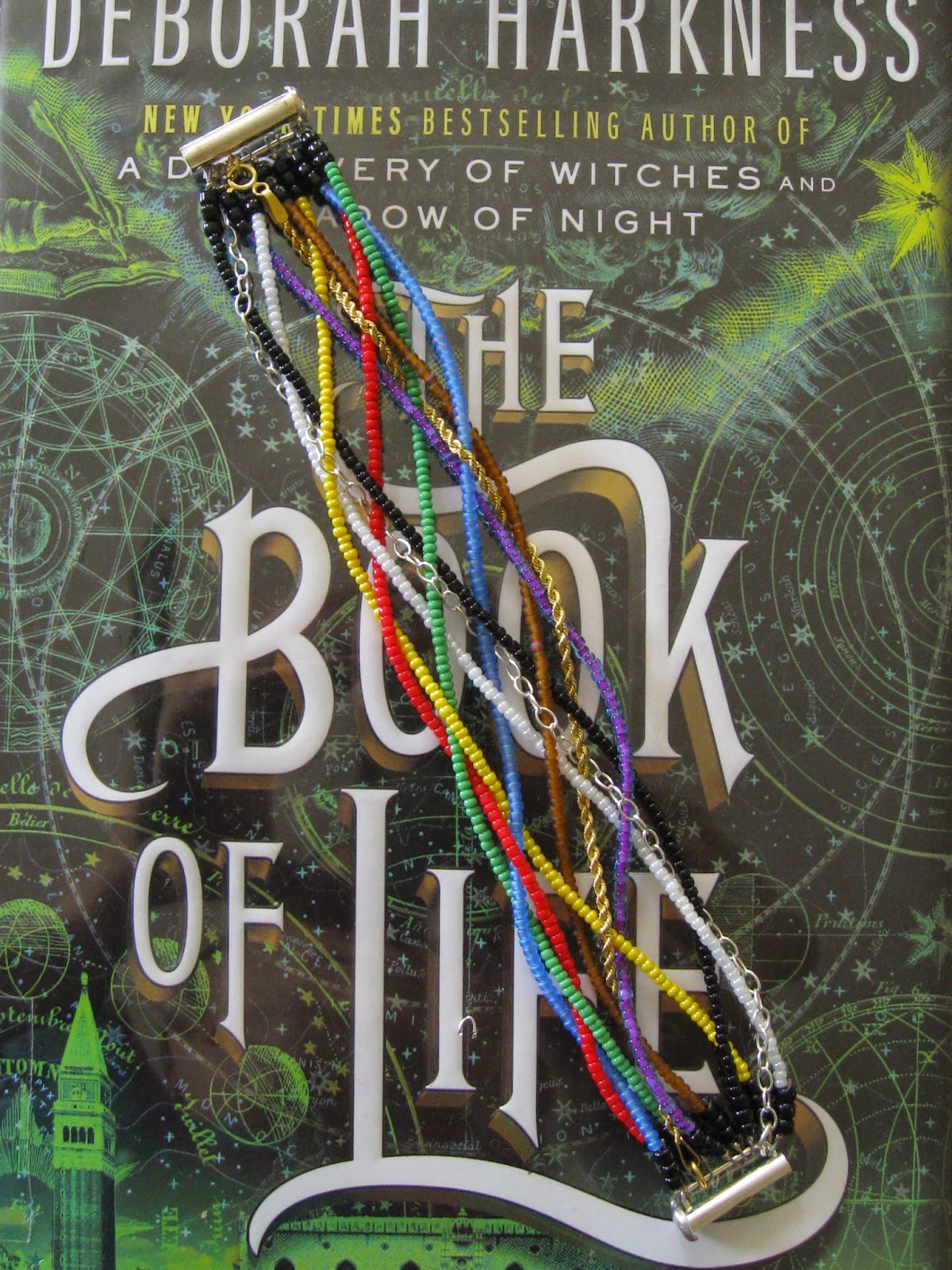
The Book of Life,
the last volume in Harkness's trilogy, came out, I snapped it up from the library, and spent the next several nights staying up too late reading. It was as good as the previous two, filled with action and adventure, science and history, and magic and romance. The secrets in the titular Book of Life were what I expected, and I would have liked more information about the origins and history of vampires, witches, and daemons and the implications of their relationship to ordinary humans, but the story ended satisfyingly. There were also hints that Harkness might be planning a sequel, so there's that.
As enjoyable as the trilogy was, however, it confirmed for me that I am generally not interested in modern vampire stories (with one notable exception, Elizabeth Kostova's
The Historian
). Vampires are evil. They are predators who prey on rational, intelligent beings, often in cruel ways, and their actions are a perversion of the Catholic Mass. I have trouble seeing them as decent, let alone romantic, creatures. Some creators try to address this thoughtfully. Joss Whedon's Buffyverse, for example, posited that a lack of a soul was responsible for the evil and cruelty of vampires, and if one got his soul back, as Angel did, he would be remorseful and strive to be good. But this explanation is ultimately unsatisfying -- where are the souls when they are not in vampires? Why would a soul make a difference, when demons have souls, as do humans, both of whom have no trouble committing evil? What about Spike, who as a result of a long period of moral evolution chose to do good and fight evil, and chose to get his soul back so that he could be an even better person?*
Other creators never really address the problem of evil at all, and leave it to individual vampires to choose to do good or evil or both, like everyone else. Anne Rice took this approach (at least in the first couple of volumes), focusing on the personal cost and effects of vampirism. It is also the approach Harkness takes, but she also goes to some pains to develop a vampire social contract of sorts, which as she puts it is about "law, honor, and justice"; mercy and charity have no role. She creates an elaborate set of rules governing vampire behavior, but it ultimately boils down to "might makes right," and that is something I find neither attractive nor interesting. Matthew, being the hero, is always striving to do the right thing, but that is more a vestige of his human life -- his Catholic faith -- rather than a trait of his vampireness. He is concerned with notions of sin and atonement and forgiveness, but many other vampires think him rather odd in this, and their good deeds tend to extend only to protecting those they love rather than any abstract notion of decency or charity.
By contrast, the witchy society seems much more humanlike in its approach to morality (although we do not spend nearly as much time in their culture). Which is not to say there aren't evil witches; there are, and those in power are slow to punish them, but they are all motivated by the usual reasons rather than a species-wide justification. That, plus their neato magic, makes them far more interesting to me than the vampires. I hope any sequel focuses more on their world, and that of the daemons who were rather short-changed in the trilogy.
*I recently read that Whedon has stated he had no real education in any religious traditions, and that explains the screwy theology of is world -- not just the soul issue, but demons who are nevertheless sometimes good, and more critically the existence of a great, overarching "First Evil" with no apparent good counterpart, something that is present in pretty much any real world religious or mythological system that stresses the fight between good and evil.


 Luckily for me, I had already read it and most of his other works in Spanish. So with some relief (and a bit of guilt) I picked up my husband's English copy. Of course, it's foolish to let the language issue keep one from such a great work of art, and I'm glad I didn't. 100 Years is considered García Márquez's greatest work for a reason. In his depiction of seven generations of the Buendía family living in the odd town of Macondo he encapsulates the history of Colombia, from exploration, conquest, and immigration to civil war, the
  The third installation in the series, and I don't have much to say except it was as enjoyable as expected. Also, now I want a
  Also enjoyable, with a good mystery that was neither too predictable nor too implausible. The education in homelessness was laudable, if heavy-handed. What wasn't laudable was an extended advertisement for a sizeable needlecraft store in North Dakota.
 A recent addition to another cozy, quilty mystery series, set in a farming and ranching community in California. What sets this series apart is the very real kindness Fowler has towards all her characters; in her world, people are bundles of positive traits, serious and not so serious flaws, and contradictory behaviors. She is not afraid to depict complicated characters capable of both good and evil in serious and petty matters, making her stories that much more satisfying.
 Mostly set in France just before the revolution, about a young artist and inventor fascinated by mechanical works, the book tells his life from the start of his education to the creation of his masterpiece. The structure mirrors both the case of curiosities that is the title -- a box of nine ordinary objects representing key periods of his life -- and the watch which indirectly starts him on his journey. The idea of summing up a life in a collection of objects whose symbolism is only apparent to the collector is neat, and I enjoyed seeing what the significance was of the different objects (the watch structure, on the other hand, I didn't even notice until it was spelled out at the end).
 The advent of baseball season put
me in the mood for this, an account of the absurdist 1973-1975 Texas
Rangers team. When your team has no hope of hitting .500, you might as
well embrace the egotistical and talentless hitters, the pitcher who
deliberately shot himself in the hand, the other pitcher who called a press conference to
announce he just threw spitballs, the outfielder given a whistle to blow
because he couldn't remember to shout "I've got it!", the long-suffering manager with
no illusions, the greedy owner coming up with ridiculous schemes to
generate revenue, scarily blunt
groupies, and the booze. Oh my God, the booze.
The advent of baseball season put
me in the mood for this, an account of the absurdist 1973-1975 Texas
Rangers team. When your team has no hope of hitting .500, you might as
well embrace the egotistical and talentless hitters, the pitcher who
deliberately shot himself in the hand, the other pitcher who called a press conference to
announce he just threw spitballs, the outfielder given a whistle to blow
because he couldn't remember to shout "I've got it!", the long-suffering manager with
no illusions, the greedy owner coming up with ridiculous schemes to
generate revenue, scarily blunt
groupies, and the booze. Oh my God, the booze. Seasons in Hell was fun, but Ball Four is the superior book, and the original baseball "tell-all." Bouton is a former ML pitcher, and the book covers the year he spent pitching for the one-season Seattle Pilots (plus three addenda for each additional decade). Bouton's status as an insider and as a pretty smart and insightful guy result in a fascinating account of what baseball was like for the players in the years before free agency. Although a lot of the stories he relates are fairly tame by today's celebrity-scandal standards, the book was hugely controversial when it was released; management had invested a lot in the idea of baseball players as Wholesome American Heroes, and finding out that they were often underpaid and mistreated, used drugs, drank a lot, played jokes on each other, chased women, and cussed would result in fans abandoning baseball! (Ha.) Some of the players, too, weren't too happy with the exposure, although to Bouton's credit he is never mean-spirited or cruel to his fellow players.
 Math + Baseball = Awesome. This is the story of how one general manager, Billy Beane of the Oakland A's, defied baseball's conventional wisdom by using sabermetrics to build the best baseball team on the cheap. It's a fascinating account of how some obscure but crucial baseball skills are completely undervalued, because people (agents, scouts, managers, owners) are too focused on flashy statistics like batting average and win/loss records. This book was especially enjoyable for me as a Red Sox fan, because at the end of the season depicted, 2002, Beane turns down an offer to be the GM of the Sox. Instead Theo Epstein took the job, determined to bringing sabermetrics to Fenway, and had
  is the second volume of Harkness's trilogy, and I enjoyed it just as much. It got off to a slow start, as the first 200 pages are spent on Diana and Matthew acclimating to Elizabethan life. Harkness goes into quite a bit of detail describing dress, culture, household and village functions, and all the famous people (of course) Matthew knew/knows. But once the couple gets married for the third time (yes, really), and remembers why they went to 1590 in the first place, the novel picks up quite a bit. We get a few more clues about the mystery of the alchemical book at the heart of the story, and hints at the true relationship among the different species. Diana finally comes to terms with her magical heritage and begins to learn how to control it; it was gratifying to see her regain some agency, even managing to rescue herself from the obligatory peril.
  so I bit. And I'm glad I did -- this book was smart and fun. The world-building was fascinating, the mystery at the core of the plot involves alchemy, history, and genetics (Harkness knows her stuff), and the hero and heroine were refreshingly honest with each other (impressive, given all the secrets everyone is keeping). Harkness even managed to avoid
  by Margalit Fox concerns the decipherment of Linear B, the writing system used by the Mycenean Greeks in the late Bronze age. It's not about Michael Ventris, the man who actually cracked the code, however, but about Alice Kober, who worked for decades on the script but died before she could decipher it. It was her insights and tremendous cataloging efforts that gave Ventris the tools he needed to succeed. Not surprisingly, Kober's efforts have been overlooked by academics who generally didn't pay too much attention to women at that time, no matter how smart. This book is Fox's attempts to correct that, and to bring both Kober and her work to light.
 But then, that should be no surprise -- an urban fantasy novel that incorporates ancient mythology, the Mob, Arthurian elements (including my beloved
  by Neil Gaiman, which has much in common thematically with Last Call.
 also by Powers.
 by Dylan Thomas: Thomas is most famous for his poetry, so it is no surprise that this prose work is remarkably lyrical and impressionistic. Thomas strings together memories from his childhood to form a perfect Christmas, where even the snow was better than it is now. A lovely little story.
 by Lemony Snicket: A slight but amusing "fable," with Snicket's trademarked wordplay and sensibility.
 by David Sedaris: I read this every year, to prevent any undue seasonal sappiness. The stories are a mix of fiction and (exaggerated?) memoir, skillfully satirizing the expected targets -- commercialism, empty pieties, and Christmas letters.
 is a straight-up superhero novel, narrated by Dr. Impossible, who breaks out of prison to enact his latest plan to take over the world, and Fatale, a recruit in the
  , although Grossman's story is far kinder, quite poignant in its depiction of lonely, regretful, mixed-up metahumans.
  is a magic realism novel about the recently deceased Vincent Ettrich, a rather benign womanizer who is returned to life so that he can raise and teach his unborn son, fated to save the universe. We never find out too much about why his son is so important, or what exactly he is supposed to do in the future, but that's not the point. Instead the focus is on Vincent himself, and the mother of his child, Isabelle, both of whom must overcome their flaws and weaknesses if they are to defeat the forces of chaos and keep their son alive.
 may very well replace
  as my favorite McKillip novel. It contains many of the elements from previous books -- bards, unconventional young women, conquering armies, magic tied to the land, mysterious characters out of myth -- and combines them into one enthralling tale. As with most of her writing, McKillip is a little weak in characterization and there can be a sameness to her world-building, but her language and stories more than make up for it. This one, about a reluctant scholar trying to learn the truth of an ancient and dangerous bardic contest (and so much more), is no exception.
 for some time now, and I finally did! (Yeah, not a big achievement in the grand scheme of things.)
 is the story of the Epic of Gilgamesh -- what is known of its creation, its loss when Nineveh fell, and its rediscovery in the nineteenth century. As intriguing as this story is, it is rather short, so Damrosch fills out his narrative by offering us a lot of context. We learn about the scholars who decyphered cuneiform and translated the Gilgamesh tablets, the archeologists who uncovered Nineveh and its ruined library, the state of British archeology in the late 1800s (racist, classist, and ridiculously petty), the Assyrian kings who founded Nineveh and put together the great library of cuneiform tablets, the workings of the Assyrian Empire (surprisingly modern in its politics and concerns), and finally the earliest Sumerian and Akkadian versions of the Gilgamesh stories. Damrosch, a comparative literature professor, adds an analysis of the epic itself for good measure (helpful, since it's been years since I read it), along with its influence on modern works.
 is the first novel in a young adult series about a human boy stumbling onto , which was inevitably compared to the Harry Potter series. However, that does a disservice to Colfer, who has created a world with a completely different vibe -- one much more technologically detailed and action-oriented, where the focus is less on good v. evil and more on caper v. counter-caper.