As soon as
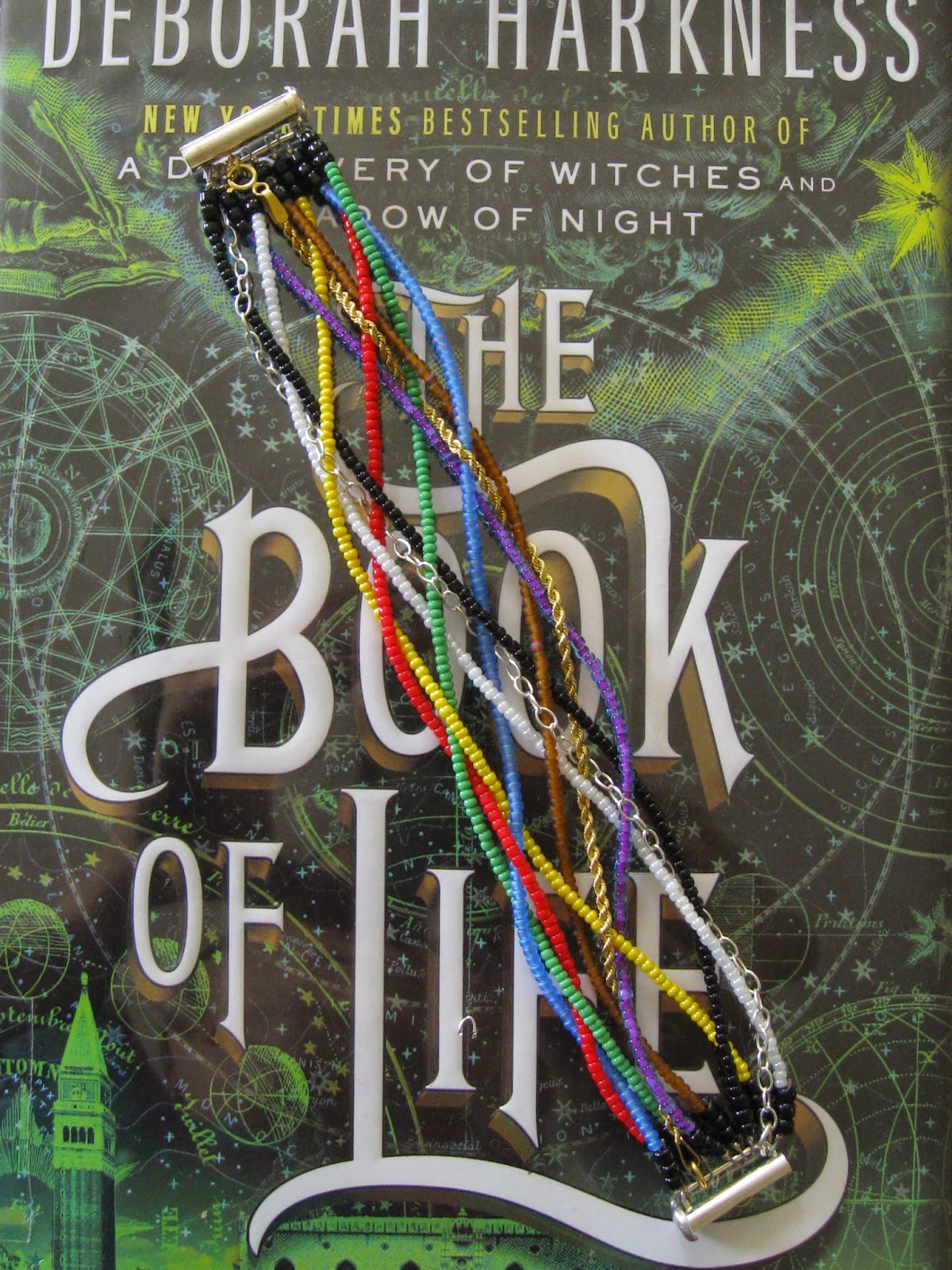
The Book of Life,
the last volume in Harkness's trilogy, came out, I snapped it up from the library, and spent the next several nights staying up too late reading. It was as good as the previous two, filled with action and adventure, science and history, and magic and romance. The secrets in the titular Book of Life were what I expected, and I would have liked more information about the origins and history of vampires, witches, and daemons and the implications of their relationship to ordinary humans, but the story ended satisfyingly. There were also hints that Harkness might be planning a sequel, so there's that.
As enjoyable as the trilogy was, however, it confirmed for me that I am generally not interested in modern vampire stories (with one notable exception, Elizabeth Kostova's
The Historian
). Vampires are evil. They are predators who prey on rational, intelligent beings, often in cruel ways, and their actions are a perversion of the Catholic Mass. I have trouble seeing them as decent, let alone romantic, creatures. Some creators try to address this thoughtfully. Joss Whedon's Buffyverse, for example, posited that a lack of a soul was responsible for the evil and cruelty of vampires, and if one got his soul back, as Angel did, he would be remorseful and strive to be good. But this explanation is ultimately unsatisfying -- where are the souls when they are not in vampires? Why would a soul make a difference, when demons have souls, as do humans, both of whom have no trouble committing evil? What about Spike, who as a result of a long period of moral evolution chose to do good and fight evil, and chose to get his soul back so that he could be an even better person?*
Other creators never really address the problem of evil at all, and leave it to individual vampires to choose to do good or evil or both, like everyone else. Anne Rice took this approach (at least in the first couple of volumes), focusing on the personal cost and effects of vampirism. It is also the approach Harkness takes, but she also goes to some pains to develop a vampire social contract of sorts, which as she puts it is about "law, honor, and justice"; mercy and charity have no role. She creates an elaborate set of rules governing vampire behavior, but it ultimately boils down to "might makes right," and that is something I find neither attractive nor interesting. Matthew, being the hero, is always striving to do the right thing, but that is more a vestige of his human life -- his Catholic faith -- rather than a trait of his vampireness. He is concerned with notions of sin and atonement and forgiveness, but many other vampires think him rather odd in this, and their good deeds tend to extend only to protecting those they love rather than any abstract notion of decency or charity.
By contrast, the witchy society seems much more humanlike in its approach to morality (although we do not spend nearly as much time in their culture). Which is not to say there aren't evil witches; there are, and those in power are slow to punish them, but they are all motivated by the usual reasons rather than a species-wide justification. That, plus their neato magic, makes them far more interesting to me than the vampires. I hope any sequel focuses more on their world, and that of the daemons who were rather short-changed in the trilogy.
*I recently read that Whedon has stated he had no real education in any religious traditions, and that explains the screwy theology of is world -- not just the soul issue, but demons who are nevertheless sometimes good, and more critically the existence of a great, overarching "First Evil" with no apparent good counterpart, something that is present in pretty much any real world religious or mythological system that stresses the fight between good and evil.



 is the second volume of Harkness's trilogy, and I enjoyed it just as much. It got off to a slow start, as the first 200 pages are spent on Diana and Matthew acclimating to Elizabethan life. Harkness goes into quite a bit of detail describing dress, culture, household and village functions, and all the famous people (of course) Matthew knew/knows. But once the couple gets married for the third time (yes, really), and remembers why they went to 1590 in the first place, the novel picks up quite a bit. We get a few more clues about the mystery of the alchemical book at the heart of the story, and hints at the true relationship among the different species. Diana finally comes to terms with her magical heritage and begins to learn how to control it; it was gratifying to see her regain some agency, even managing to rescue herself from the obligatory peril.
  so I bit. And I'm glad I did -- this book was smart and fun. The world-building was fascinating, the mystery at the core of the plot involves alchemy, history, and genetics (Harkness knows her stuff), and the hero and heroine were refreshingly honest with each other (impressive, given all the secrets everyone is keeping). Harkness even managed to avoid