Search This Blog

Monday, May 18, 2026

Book Round-up

Fried Green Tomatoes at the Whistle Stop Cafe by Fannie Flagg: I've seen the movie, of course, but I had not read the book until it was the April selection for my book club. Unlike the movie, the book follows many more characters than Ruth and Idgie (whose relationship is a lot more obvious), and the depictions of racism, poverty, and addiction in the 1920s and 30s are sometimes heartbreaking. I don't have a lot to say about it, but I enjoyed it.

The Spellshop by Sarah Beth Durst: Durst set out to write the ultimate cozy novel, and it certainly has all the elements -- books, flying cats, talking plants, bakeries, gardens, jam, and a gentle love story. I do wish she had put as much thought into the world-building; I don't need GRRM-levels of detail, but the characters were remarkably incurious about the political revolution happening in the background. On a nit-pickier level, I also wish she had done a little more research into how libraries work (manuscripts, for example, don't have publishers, and in a world apparently without a printing press books would be much scarcer and more expensive than they are now). Props to her, though; Meep the cactus is adorable.

Witch Hat Atelier by Kamome Shirahama: A cozy fantasy manga series about a little girl who accidentally turns her mother into a statue and must attend the titular atelier to learn how to undo the spell. It was cute, but I don't feel the need to read the <checks notes> … next 14 volumes.

Exit Strategy by Martha Wells: I love these novellas so much I've started buying them rather than getting them from the library. This one is as funny, thrilling, and even heartwarming as the previous ones (don't hate me, Murderbot!).

Hellboy v. 1-4 by Mike Mignola: A reread, just because. Love both the unambiguously good (despite his name and appearance) hero and the mix of folklore and horror.

Meet Me in the Moon Room by Ray Vukcevich: A collection of very short, very odd stories. Vukcevich specializes in speculative, almost absurdist fiction. The stories were hit-or-miss for me; some were quite affecting, but others were clinical, sometimes quite cold and cruel. A riff on Frankenstein ("Rejoice") was excellent.

Tuesday, April 28, 2026

Pussy Willows (a Little out of Season)

 I love decorating with pussy willows late winter/early spring, and I've long admired DusiCrafts's beautiful patterns, so I bit the bullet and bought one. And then I made two ornaments, one for my mom and one for me:


The nice thing about DusiCrafts's patterns is that she offers a lot of options -- several different versions of the pussy willow branches, some with buds and some just with catkins, Easter eggs to add to the design, and different sizes and shapes for the ornaments themselves. I liked being able to customize them a bit!
 

Monday, April 20, 2026

Book Round-Up

The Correspondent by Virginia Evans: An absolutely lovely epistolary novel about an elderly woman looking back on her life, and the wonderful, difficult, troubling relationships she had. It was well worth the months-long wait at my library.

Great Big Beautiful Life by Emily Henry: I’ve only loved Henry’s odd-numbered books, but this (her 6th) broke the pattern. Probably because it was also a departure for her, with a good chunk of the novel devoted to another elderly woman reflecting on her life and relationships (a theme this month, I guess). I know some were put off by that, but I was ok with it, especially because I tend to prefer romances that are secondary, not primary, plots.

Agnes Aubert's Mystical Cat Shelter by Heather Fawcett: Of course I read a book about a woman who runs a cat shelter and her wizard landlord. I'm loving Fawcett's take on romantasies -- fewer assholes, more humor.

Woman Hollering Creek by Sandra Cisneros: I don't know why it took me so long to read Cisneros, but I absolutely loved this collection of vivid, evocative, heartbreaking, and funny stories. My favorite was "Little Miracles, Kept Promises."

Men of Maize by Miguel Angel Asturias: Considered to be possibly the first magical realism novel, it's not nearly as famous as 100 Years of Solitude, probably because the text is quite challenging -- a loose understanding of time, opaque (to me) allusions to Guatemalan political history, extensive references to Mayan folklore and religious beliefs, and an impressionistic approach to language use. I'm so glad I didn't try to read it in the original Spanish, a particular dialect with lots of Mayan vocabulary. This edition was heavily annotated and had several essays on the author, text, and translation, which allowed me to understand much better Asturias's themes of colonialism and the degradation of the environment and left me with a desire to learn more about the Mayans. (Interestingly, there's a section very similar to my favorite Cisneros story.)


Monday, April 13, 2026

I Made a Book!

The pattern is from The Barmy Fox, based on a simple folded paper booklet design she used to make for her young students. The embroidery uses a wide variety of stitches, although I made some changes to suit my own preferences. For stability and opacity, I inserted stiff interfacing between the pages.

This is such a clever but simple way to make a booklet, and I have so many ideas I want to try with it. 


Friday, April 10, 2026

Cross Stitch Diary Part 2

 I've been making and reading, just not quite having the energy to post. (Sometimes I post on Instagram or Substack.)

A piece of cranberry pie for Thanksgiving.

Candles for Advent.

A Christmas tree.

A blue SUV because the brakes failed and we had to cancel our trip to see family.

A wedge of cheese because we celebrated New Year’s Eve with a charcuterie board (we are old and/or tired and/or introverted).

A crown for Three Kings’ Day.

A birthday cake for my oldest.

A star for Minnesota, l’Etoile du Nord (so proud of Minneapolis).

A stack of books for the ones I read in January.


Saturday, February 28, 2026

Book Round-Up

 Rogue Protocol by Martha Wells: Still enchanted by the series. I think I'm going to buy them (high praise!)

Winter's Tales by Isak Dinesen: A varied collection of tales, rigid in upholding the class system and morality, but also with sharp insights about the inherent oddness and tragedy of some people. "The Dreaming Child" in particular, about the lies we tell ourselves, has stuck with me.

Claire DeWitt and the City of the Dead by Sara Gran: I joined a book club, and this was the first (for me) pick. And I was one of the only people who liked it, ha. Ostensibly a murder mystery set in New Orleans about a year after the flood, it's by no means a conventional procedural. There are elements of magical realism, not a whole lot of detecting gets done, and Claire is an oddball (to put it mildly). Instead it's about trauma, the lack of control we have over what happens to us, and the ability to rise above it. This is the start of a trilogy and I'm looking forward to the other two.

The Librarians by Sherry Thomas: Of course I was going to read a book about librarians who solve a murder. Unfortunately, it was a bit of a disappointment. I liked the characters and the story, but the whole thing felt engineered, like the author was given a checklist of modern topics, character traumas, and pop cultural references to incorporate.  A more organic version of the story would have been perfect.

English Is not Easy by Luci GutiƩrrez: This is a delightful graphic novel that explains the English language to non-native speakers. For a native speaker like me, the value is in the quirky, funny, occasionally bawdy illustrations.

Tuesday Mooney Talks to Ghosts by Kate Racculia: This story has the titular character go on a scavenger hunt arranged by an eccentric millionaire while dealing with the ghosts (figurative and literal) of her past, but it took an unexpectedly dark turn towards the end. Still, it was fun and engrossing, and filled with a number of great characters.

Wild Dark Shore by Charlotte McConaghy: another book club pick, and again I was one of the only ones who liked it. It's a family drama with elements of eco-dystopia and magical realism; normally I avoid dystopian novels at all costs, but gratifyingly this one found hope in human relationships, particularly in those of parents and children. A common reason given today for not having children is the unwillingness to subject them to climate change, but that can lead to a sort of despairing complacency, an excuse to not bother to try to solve the very many problems we are facing. Future generations can and should inspire us to work towards the common good. I think some of my fellow club members were hung up on the lack of explanation for the some phenomena and motives in the novel, whereas I'm more comfortable with unanswered questions. It's a sad novel, but gorgeous in its own way.

Wednesday, February 18, 2026

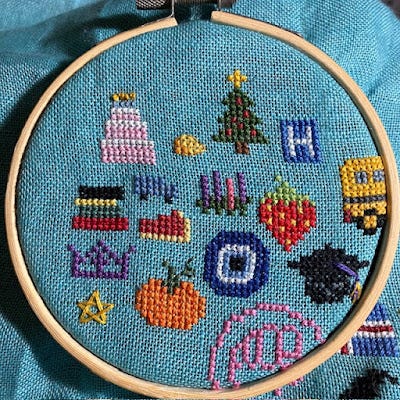
Cross Stitch Diary

 Inspired by The Daily Stitchuation, I've started a stitch diary (not my first one). For my own sanity, I'm not forcing myself to stitch every day, or create a motif for each day. 

Part 1:

 A cap, because my Down Syndrome son finished high school.

A strawberry, because I love them.

An evil eye, because I was reading about them.

A resist symbol, because Trump.

The flag of Iceland, because I read Sjon's Codex 1962 (and I want to go someday).

A hospital symbol, because my son had minor surgery.

A school bus, because the privatized bus system in NYC suuuuucks.

A tear, because life is hard.

An apple, pumpkin, and leaf because I love fall.

A witch's hat because I crocheted one a week before Halloween.

Part 2:

 A piece of cranberry pie for Thanksgiving.

Candles for Advent.

A Christmas tree.

A blue SUV because the brakes failed and we had to cancel our trip to see family.

A wedge of cheese because we celebrated New Year's Eve with a charcuterie board (we are old and/or tired and/or introverted).

A crown for Three Kings' Day.

A birthday cake for my oldest.

A star for Minnesota, l'Etoile du Nord (so proud of Minneapolis).

A stack of books for the ones I read in January.

Friday, February 13, 2026

The Bone Clocks by David Mitchell

Mitchell's novel, set in the same world as Cloud Atlas (and all his other novels), has a similar formal structure: it's divided into six parts, each a different kind of story -- coming-of-age, Faustian bargain, war memoir, literary satire, metaphysical fantasy, and eco-dystopia. Underlying the narrative, though, are references to a war between the mysterious Horologists and Anchorites; the former are trying to protect humanity from the latter, who want to use humans as fuel in their quest for immortality.

 But it’s not until late in the novel we learn this, and with the exception of the fifth section we spend little time with the Anchorites and Horologists themselves. Instead every part serves as a character study, each one narrated by someone with a connection to Holly, the first narrator and the key to the novel as a whole. in each of these sections we see the characters make bad or even disastrous decisions, but what matters is the fallout — not just the consequences to the plot, but the effect on the characters and what they choose to do after. 

 It's here that Mitchell demonstrates his skill as a writer. Most of the characters are deeply flawed, often making stupid, selfish, or evil choices, but Mitchell lets us see what drives them to make those choices. The fourth section in particular stood out -- it's the section that covers the longest time period, allowing us to see an arrogant, self-involved writer ever so slowly repent and learn to put others before himself. On the other hand, the fifth section, while fun and fascinating, felt out of place. The sixth section returns us to ordinary humans, but, set in a near future ravaged by climate change, it displays a deeply cynical attitude about humanity, something that seems almost like a betrayal of the poignantly-depicted characters of the rest of the novel.

Despite my disappointment in the ending, I fully intend to read more of Mitchell's work. The world he has created is filled with wonderful characters and fascinating bits of lore.

Friday, January 16, 2026

A Long-Overdue Christmas Wrap-up

 It's been a tough month.

On the crafting front, I started Sue Spargo's Christmas tree pillow project. I cannot actually afford any of her kits, though, so I worked out of my stash. In the process I changed some motifs and stitches to suit my tastes, such as adding a manger scene because Christmas isn't secular for me, and eliminating most bullion knots because those are the devil's stitch. What I have so far:


I also stitched this freebie from Momentoell. I like the chunky effect she gets by using 6 or even 12 strands of floss. The lovely, soft colors are a nice change of pace, too, from the usual embroidered Christmas tree.


Not much jewelry making happened, but I did remake a bracelet (which apparently I never photographed) with several Christmas-themed charms into a necklace. No point in wearing a bracelet if my wrists are covered up in several layers of long johns and wool sweaters (it's so cold where I work).


My middle son gave me a skein of acrylic yarn for Christmas. I love the color, but it is too scratchy to wear so I crocheted a garland. This worked up so fast and fun I made a second with a different yarn.


He also gave me more buttons, so I made a button garland for the tree.


And I finally finished my youngest's quilt: 


On the book front, I read three Christmasy books:

The White Priory Murders by Carter Dickson: An enjoyable locked-room mystery, where, amusingly, Dickson had two characters immediately propose the most obvious explanations to accuse each other. John Dickson Carr was name-checked in the locked-room mystery Wake Up Dead Man, too, which was a fun little easter egg.

Snowed In by Catherine Walsh: a cute holiday-themed contemporary romance, related to her previous novel, Holiday Romance. I enjoyed it, but it lacked an effective structure to hang the story on.

Golden Age Christmas Mysteries ed. by Otto Penzler: some of these would better be classified as spy thrillers or adventures, but all were enjoyable. The collection runs the gamut from light-hearted, comedic stories to darker, melancholic ones, so there's something to suit most tastes.

I think that about wraps it up. Aside from the food, cancelled trip, car troubles, pretty snow fall, improv king cake ...

Wednesday, December 10, 2025

Threads of Life by Clare Hunter


Needlework has often been dismissed as just women's work -- a hobby, a distraction, a trivial thing done with one's children. Frasier Crane superciliously claims he supports the arts, not the crafts. Tim Gunn on Project Runway warned contestants to not be too artsy-craftsy. Occasionally, needlework is treated as an art form, most notably as part of William Morris's Arts & Crafts movement, but I suspect his sex -- and his interest in more "serious" art forms -- had a role.

Which is why Hunter's Threads of Life is so critical to understanding the power of needlework. Each chapter explores one aspect the art has brought to women's lives, such as protection, identity, and voice. Some sections include research into ancient and historical practices, techniques, and cultural contexts; others profile one or more women and their art. Some of these stories are enraging: Lorina Bulwer was imprisoned in a workhouse by her brother when their mother died; she spent the rest of her life there, embroidering long screeds in block letters detailing her anger at the unfairness of how she was treated. Others are heartbreaking: Hmong women, stuck in refugee camps after years of wars and persecution, created story clothes to tell what they had lost and endured. 

The stories are not always bleak. Embroidery has also been a source of power -- as symbolism, as what queens would choose to wear, as financial stability, providing a steady income for women
, as art, allowing women to create meaningful and beautiful statements, as community, encouraging women to seek friendship and advice, and as protest, allowing women to speak out about the injustices of the world and bring about change. Anyone who is interested in needlework, and anyone interesting in women's history, will learn much from this book.

Monday, November 24, 2025

Book Round-Up

 Cold Clay by Juneau Black: Sad to say, I didn’t enjoy this one as much as the first. The authors have created fun characters in a delightfully cozy setting, but the actual writing in this novel was not great — both overwritten and messy.

Moon over Soho by Ben Aaronovitch: I’m enjoying the Rivers of London series, an urban fantasy about a police officer learning to become a wizard. This one centered around jazz music and its vampiric fans.

The Book of Lost Things by John Connolly: This book, about a boy who finds himself in a world of fairy tales, was a lot darker than I expected, but it was a moving exploration of grief and growing up, deeply satisfying by the end. The only flaw was the chapter with Snow White, which was completely out of place tonally.

The Bewitching by Silvia Moreno-GarcĆ­a: This was a bit of a disappointment; it has lots of interesting elements and characters, but it doesn’t quite cohere, feeling more like a draft than a finished novel. Some elements are left dangling — ownership of the land, so critical in 1908, is not mentioned at all in 1998, and Minerva talks about her mother and great-grandmother, but her grandmother is entirely missing. Then there’s Alba’s relationship with her putative lover: Alba, and the narrative itself, treat it as if it were merely inappropriate and not absolutely awful. I don’t regret reading it, but I didn’t enjoy it as much as Gods of Jade and Shadow.

The Other Side of Midnight by Simone St. James: I try to read a Simone St James novel every fall; she excels at mysteries that are spooky and romantic. I didn’t love this one as much as the first two I read, but it was an enjoyable, creepy-but-not-too-creepy story about psychics real and fake.

Hemlock & Silver by T. Kingfisher: Kingfisher's novels have certain commonalities -- middle-aged characters with ordinary jobs, humor to counterbalance the horror and weirdness, and a pantheon of saints and gods -- but the settings and stories are varied and inventive. This one takes the elements of Snow White (queen, daughter, mirror, apple) and puts them together in an utterly novel way. I just can't get enough of Kingfisher, and I'm pacing myself through her extensive bibliography.

Friday, November 21, 2025

I'm Hanging on to Fall as Much as I Can

 Because it is my favorite season, and because I don't want to rush Christmas.

This pattern, from and old issue of Love Embroidery magazine, was designed by Elahe at Momentoell and is now available on her website (along with many other lovely ones). Her thing is using all six strands, and even twelve, of cotton floss, which gives the embroidery a chunky, dimensional look. For even more textural effect, I used wool thread for the pumpkins and linen threads for the stems (but the latter isn't quite so obvious). I'm really pleased with this design, especially the soft fall colors.

Tuesday, November 4, 2025

Belated Crafty Halloween Post

I was so busy finishing up some crafts, helping my kids prep for Halloween, and the usual ridiculous drudgery I never got a chance to show off what I made in October.

Those cheapo witch's hats you see in stores this time of year are too small to fit my giant head, so clearly the solution was to make one of my own:

The pattern is the Twisted Witch Hat by Stephanie Pokorny. I used two strands of black worsted weight yarn (I have GOT to stop picking patterns with multiple strands of black), and counted on both Stephanie's instructions to go up a hook size at a certain point and my own loose stitching to get the right circumference. And because of said loose stitching, I eliminated a few rows in the crown and brim (also, I ran out of yarn). The curl at the tip is maintained with 16-gauge floral wire. And to make it pretty (we need more beauty in the world) I crocheted some flowers, using the patterns here and here.

Earrings!

I've seen variations of the adorable floral ghost earrings for a couple of years now, so I finally made a pair for myself. The two skull pairs of earrings are part of my ongoing effort to create the perfect calaverita/sugar skull earrings. I'll get there someday.

Monday, October 27, 2025

Book Round-Up: Cozy Witchy Edition

Thornyhold by Mary Stewart: Just about the gentlest possible story you could imagine about witches in a small English village. As with most of Stewart's romantic suspense novels, the protagonist is an orphan looking for a purpose. In this story, she inherits a cottage from her witchy aunt and finds among her neighbors a busybody who seems to have powers of her own and a handsome widower with an adorable son.

 The Very Secret Society of Irregular Witches by Sangu Mandanna: Just about the coziest story you could read about witches in a small English village, complete with magical potions, adorable moppets (three daughters this time), a goofy dog, and a sweet romance. As one would expect from a modern romance, the magic is a much bigger deal than in Stewart's novel and the characters are dealing with not just a growing attraction but their own past trauma. It was lovely, and I look forward to Mandanna's other novels.

 Howl’s Moving Castle by Diana Wynne Jones: Just about ... eh, I guess third time's not the charm. While waiting for some holds to come in at the library, and having just watched Miyazaki's adaptation of Howl, I decided to re-read it. Some day I have to get the sequels.

 Cackle by Rachel Harrison: Every once in a while I feel like my understanding of a book is vastly different from others’, or at least of those who are active online. Cackle is often described as a cozy, witchy, feminist novel, and it is that, but there is serious psychological horror underlying it. “It’s about female friendships, and not needing a man to have a fulfilling life!” It is, but it is also about how friendships can be just as toxic as romantic relationships. “It’s about empowerment and discovering your authentic self!” But Annie’s empowerment comes at the expense of a whole lot of people. The life Annie ultimately chooses – carefree, living day to day, enjoying nature and beauty and good food – seems like a dream to anyone mired in the daily grind, but it is ultimately a superficial life, lacking in meaningful connection or purpose of any kind. Annie finds herself but loses her humanity, and to me that is a horror.

Friday, October 24, 2025

Double, Double, Toil and Trouble

This was a fun little project, although not quite done. The cross stitch design is Oddpothecary by Noctiflora Designs, from the Just Cross Stitch Halloween issue from 2024. I did redesign two of them, changing bat wing to wool and frog bones to toes to better fit the quotation from MacBeth.

Meanwhile, A Somerset Halloween featured a cute project from Patty Thurlby, using altered Altoid tins to hold fun little Halloween treats. The tins were supposed to be covered in gold leaf, but that was a fiasco -- neither my local craft store nor Michaels had real gold leaf, so I used a fake version from the latter. I then tried applying it with double-sided tape, tacky glue, and the glue recommended for gold foil, but each failed in a different way šŸ™„. I eventually painted the lids in black and the rest in a metallic copper. I backed the cross stitch with heavy-duty fusible interfacing and trimmed them (I should have made a template first), then glued them to the lids. I then glued a bit of yarn around the edges of the fabric. Maybe I'll add a second cord around the top. Or dimensional paint; that could be cute.


The insides of the tins are unaltered; I want to decoupage some spooky paper images, but my paper craft stuff is stored away at the moment. I shredded bits of yarn for the wool and found a package of eye cabochons for the eyes, but  I haven't yet come up with a thing to be the frog toes.

It's not quite the look I was envisioning, but overall I'm pleased.

Sunday, September 14, 2025

Book Round-Up

 Paladin's Hope by T. Kingfisher: The third in T. Kingfisher's Saints of Steel series. I am loving the world she has created: the gods, wonder workers, gnoles, and lawyers.

Artificial Condition by Martha Wells: I think I loved this one even more than the first. ART is a great addition, and it's fun to see Murderbot acquire friends and allies despite its best efforts.

Say You'll Remember Me by Abby JimƩnez: I enjoyed this well enough, and appreciated that the central conflict came from the characters' circumstances rather than a misunderstanding or three. This novel is apparently heavier than her others (it's my first JimƩnez book), but I thought it was handled sensitively.

Proto: How One Ancient Language Went Global by Laura Spinney: this book about the development and spread of the Proto-Indo European language and its descendants would make an excellent companion to Who We Are and How We Got Here -- both argue that the evidence increasingly supports the idea that humans have always been migratory, sharing genes, technology, and language for the betterment of humanity, despite what certain politicians would claim.

Seduction Theory by Emily Adrian: I'm a sucker for academic satires, and this novel, purporting to be a master's thesis that dissects the marriage and infidelities of its star professors, fit the bill. At one point one of the professors, teaching a course in writing, mentions the need to strip out the conceits of a story to see what is left. At the core of this novel is the complicated portrait of a particular marriage, and a person on the outside looking in.

Wednesday, September 3, 2025

Quick Jewelry Hits

A colleague at work has one of those gemstone initial necklaces that are so popular. I have a strand of tiny gemstone rondelles and assorted gold charms. The result:

Have you heard of fordite beads? Pretty amazing what gets made from paint scraps. I got a strand (not cheap) and used some of them to make hoop earrings, adding tassels I had lying around. Because these beads are not actually made from glass or stone (although they look it), they are lightweight to wear.

Humblebeads had a cute tutorial for a bird bracelet using wirework techniques. The copper wire I used for the links wasn't the right gauge, so I may remake it in the future.

I was finally able to get some large freshwater pearls with large holes, which allows me to use cords and techniques I otherwise couldn't (pearls are usually drilled with tiny holes to accommodate only silk thread). First up is a stretch bracelet, inspired by some bracelets Candie Cooper made.

Finally, I remade a wire-wrapped ring I made decades ago that was fun and pretty but too uncomfortable for me to wear. After cutting it apart I glued the central flower bead with its two glass bead toppers to a ring black -- much easier to wear. The cluster of beads and charms that dangled from the old ring became the center of a simple necklace, to which I added a few more beads and charms. 


Wednesday, August 27, 2025

The Watermark by Sam Mills

 Mills's The Watermark is billed as a "quirky, literary love story" but it's a lot weirder and less romantic than that would imply. Rachel and Jaime are two Brits who are captured by a famous author (Augustus Fate) who forces them to drink a magical tea that keeps them trapped inside one of his novels; he's decided that having real people as his characters makes his writing better. In an attempt to escape the author's clutches, the pair flee into other novels hoping to find a way back into the real world.

So it's obviously metafiction, and it brings to mind both Jasper Fforde's delightful series and literary works like Miguel de Unamuno's Nieblas (Mist in English), where the main character gets into an argument with Unamuno himself (see also the romance novel Hero Worship, where the heroine finds herself in a historical novel and decides she can improve the story). The mechanism by which Jaime and Rachel are able to travel from book to book doesn't make complete sense, but that's not really the point; it rarely is in metafiction.

Instead, Mills is focused on the way stories, and art in general, can be controlled -- manipulated, commodified, and politicized. From the Fate's manuscript, a Victorian novel where tradition, religion, and capitalism are used to tightly control people's behavior, the duo move into a fictional novel written by another of Fate's victims; he promises to let the characters do what they want, but they run up against the limits of that when a world is not fully thought-out. From there it's a dismal novel about the tension between communism and fascism, two systems notoriously averse to artistic and literary freedom. A later section takes place in a quasi-dystopian future, where widespread use of robots with artificial intelligence forces humans to wrestle with who can make art and what its purpose is.

In a novel about stories and control there are, unsurprisingly, numerous references to the idea of the author as God (Fate's name is a little too on the nose), an attitude Jaime, a fervent atheist, especially latches onto. This, of course, ignores the fundamental Christian concept of free will -- God rather famously lets us do what we want (hence the Problem of Evil), which is the opposite of how Fate behaves as he tries to bend Jaime and Rachel to his will. But despite the references to God as author and Fate himself (that name!), not much time is spent on the influence of the supposed authors of these novels within novels. Instead it's more about breaking free of the stories we tell ourselves that can limit and even trap us.

This isn't the only concern of the narrative. With Rachel in particular Mills illustrates the way stories can also be an escape, and how that can be its own trap. When the novel opens, Rachel is struggling with grief, artistic block, and depression, and is not sure she wants to keep going. The idea of being in someone else's story and ceding control is deeply tempting, and it puts her in conflict with Jaime, who is desperate to get back to the real world. Complicating matters is the fact that there is no way for them to predict who remembers what every time they enter another story. One of the lovely parts of this book, then, is watching Rachel find purpose and meaning over the course of her journey.  

When they finally escape for good, it's into the Covid pandemic. Coming to in the midst of a bewildering lockdown environment adds a dreamlike quality that causes them to wonder if they really did escape. The novel ends on a somewhat melancholy note -- they've escaped, but the future is uncertain. It's not a traditional "happily ever after," but their love and their commitment to life is strong. Not everything worked about this novel, but I liked a lot of it, and I will be looking at more of Mills's writing.

Thursday, August 14, 2025

CoDex 1962 by Sjón

Sjón's post-modern novel is comprised of three novels he wrote over twenty years: Thine Eyes Did See My Substance ( a love story but not really), Iceland's Thousand Years (a mystery but not really), and I'm a Sleeping Door (science fiction but not really). All three are narrated by Jósef Loewe and purport to be his autobiography, but in the tradition of Tristam Shandy, he is not even born until the end of the second part. Instead, the bulk of the narrative is focused on his father's trials as a Jew who escapes Nazi Germany and settles as a refugee in Iceland. 

The story itself is a metafictional narrative that plays with storytelling, weaving together folktales, history, Biblical stories, and fragmented accounts. And like a lot of metafiction, it's about the stories we tell ourselves to make sense of our lives and the world around us. Maybe Jósef is the child of a desperate woman so mired in grief and alcohol she has lost track of where she's been or who she's been with. Or maybe he is a golem, lovingly sculpted from clay by his father and mother and brought to life with the word "truth" and the seal from a gold ring. 

Just as the bones of a patient afflicted with Stone Man Syndrome react to blows by swiftly forming a new layer of bone tissue over the site, so Jósef's mind wove a story every time he encountered a painful thought or memory.

Images and ideas recur throughout and characters are connected in surprising ways. Iceland is a small nation, but this is also a story being told to a listener. These elements, and the frequent interruptions from the listener, remind us of the unreliability of the narrative -- not to distance us from the characters,  but to remind us that there is a storyteller behind the story.

Parts -- especially during the section that takes place in Germany -- can be quite vulgar and upsetting, and in that way it reminded me of Gunter Grass's The Tin Drum, but this book is far more humane. Despite the prevalence of evils like anti-semitism, greed, and violence, characters display kindness towards each other and a determination to make the best of what they have. The novel ends on a melancholy note, but also the recognition that whatever else is lost, the stories live on.

All stories have their origins long before humans discovered a means of storing them somewhere other than in their memories, and so it doesn't matter if books are worn out by reading, if the print-run is lost at sea, if they're pulped so other books can be printed, or burned down to the last copy. The vitality contained in their loose ends and red herrings ... is so potent that if it escapes into the head of a single reader it will be activated, like a curse or a blessing that can follow the same family for generations. And with every retelling and garbling, misunderstanding and conflation, mankind's world of and and stories expands.


Thursday, July 31, 2025

Hoop Art

 Inspired by Nichole Vogelsinger's work, I made this:


I had a lot of fun picking different threads, stitches, and beads for all the elements. It's the second hoop I've made inspired by her work, and I will be doing more.